Does your roof need replacing, or just a repair?
A lot of commercial roofs that leak don't need to be replaced. If the damage is limited to a few areas and the rest of the roof is dry and holding up, a repair or a recoat is usually the better use of your money. See commercial roof repair for that side of things.
Replacement usually makes sense when:
- Leaks keep showing up in new places, storm after storm, even after repairs.
- Water has soaked into the roof. Wet insulation stays wet, loses its value and can damage the deck under it.
- The deck is soft or damaged in more than a few spots.
- The surface is failing across most of the roof: open seams, blisters, cracks and worn-through coating everywhere you look.
- Repairs would cost a big share of a new roof and still leave you with an old one.
The way to know is a roof inspection. We get on the roof, check the surface, seams, flashing, drains and rooftop equipment, and tell you honestly whether it can be repaired, restored or needs to be replaced.
Recover or tear-off?
There are two ways to replace a commercial roof. A tear-off removes the old roofing down to the deck, and the new roof starts from scratch. A recover puts a new roof system over the existing one, so the old roofing stays in place underneath.
When a recover can work
Sometimes a new roof can go right over the existing one. Whether yours can depends on how many layers the roof already has and what shape they're in. Building code limits how many roof layers a building can carry, so a roof that has already been covered once or twice may have to come off. The existing roof also has to be dry and solid. Any wet or damaged material has to come out either way.
When a recover is possible, it can save the time and mess of a full tear-off, and on many buildings it's a sound choice.
When a tear-off is the better call
- The roof already has the most layers it can carry.
- Large parts of the insulation are wet.
- The deck needs repairs that can only be done with the old roof off.
- The old roof is too uneven or too far gone to support a new system.
That's why we inspect first. We check how many layers are up there, look for wet and damaged areas, and then tell you which way we'd go and why. When a recover makes sense, we'll price it. When a tear-off is the better choice, we'll explain it in writing. For more on this, read roof replacement vs overlay.
Replacement options for flat and low-slope roofs
There's no single best roof for every building. Which system fits depends on the roof you have now, the building and how you use it. These are the systems we install:
TPO roofing
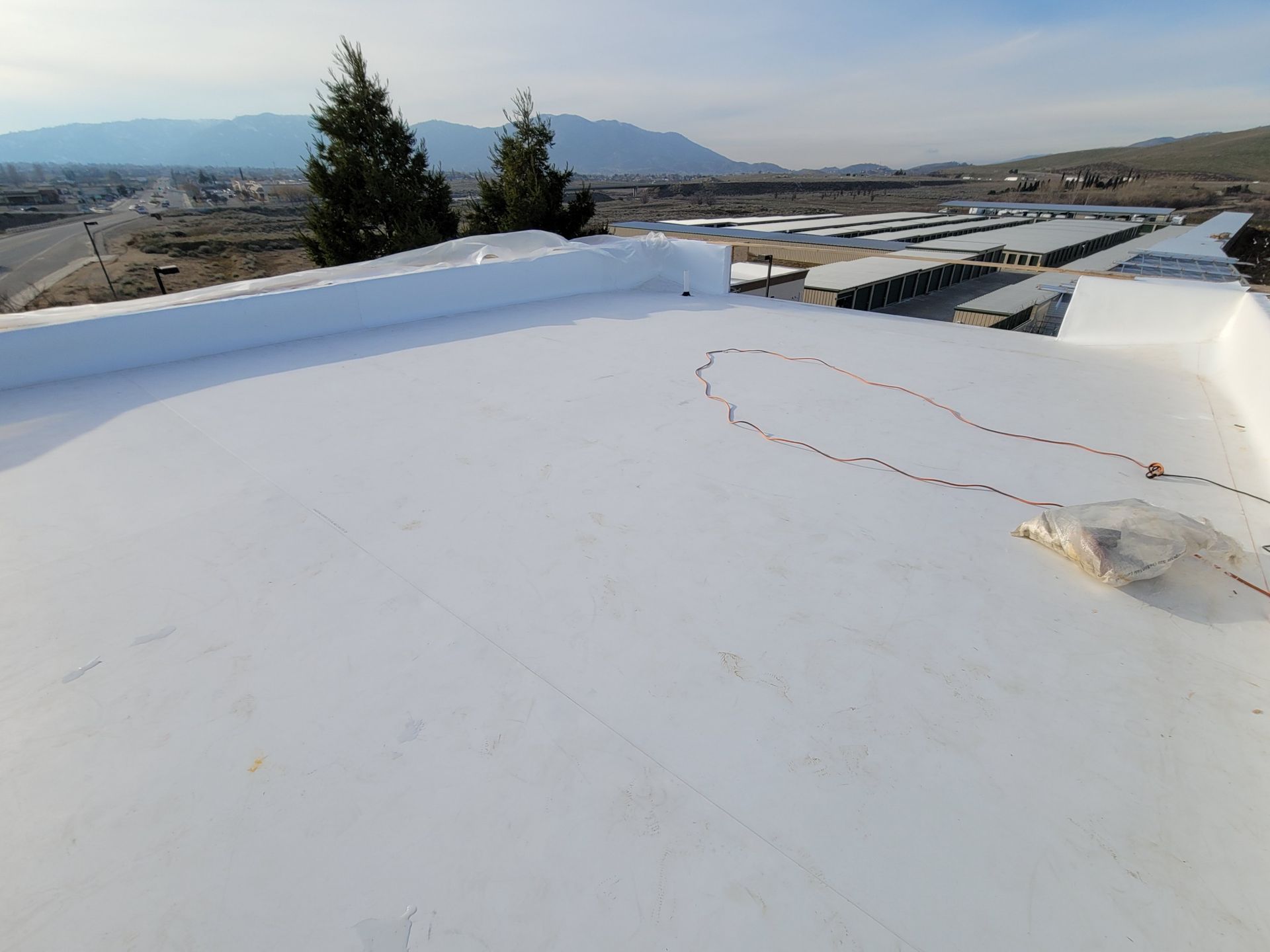
TPO is a white single-ply membrane with heat-welded seams. It reflects a lot of the summer sun, which helps on a Bakersfield warehouse, store or office, and it's a great fit for large flat roofs. It's also very repairable: a damaged spot can often be fixed by welding a patch of new membrane right over it. TPO products we install include Mule-Hide TPO. Depending on the layers and the shape of the roof underneath, TPO can go in after a tear-off or, in some cases, as a recover.
Spray foam roofing
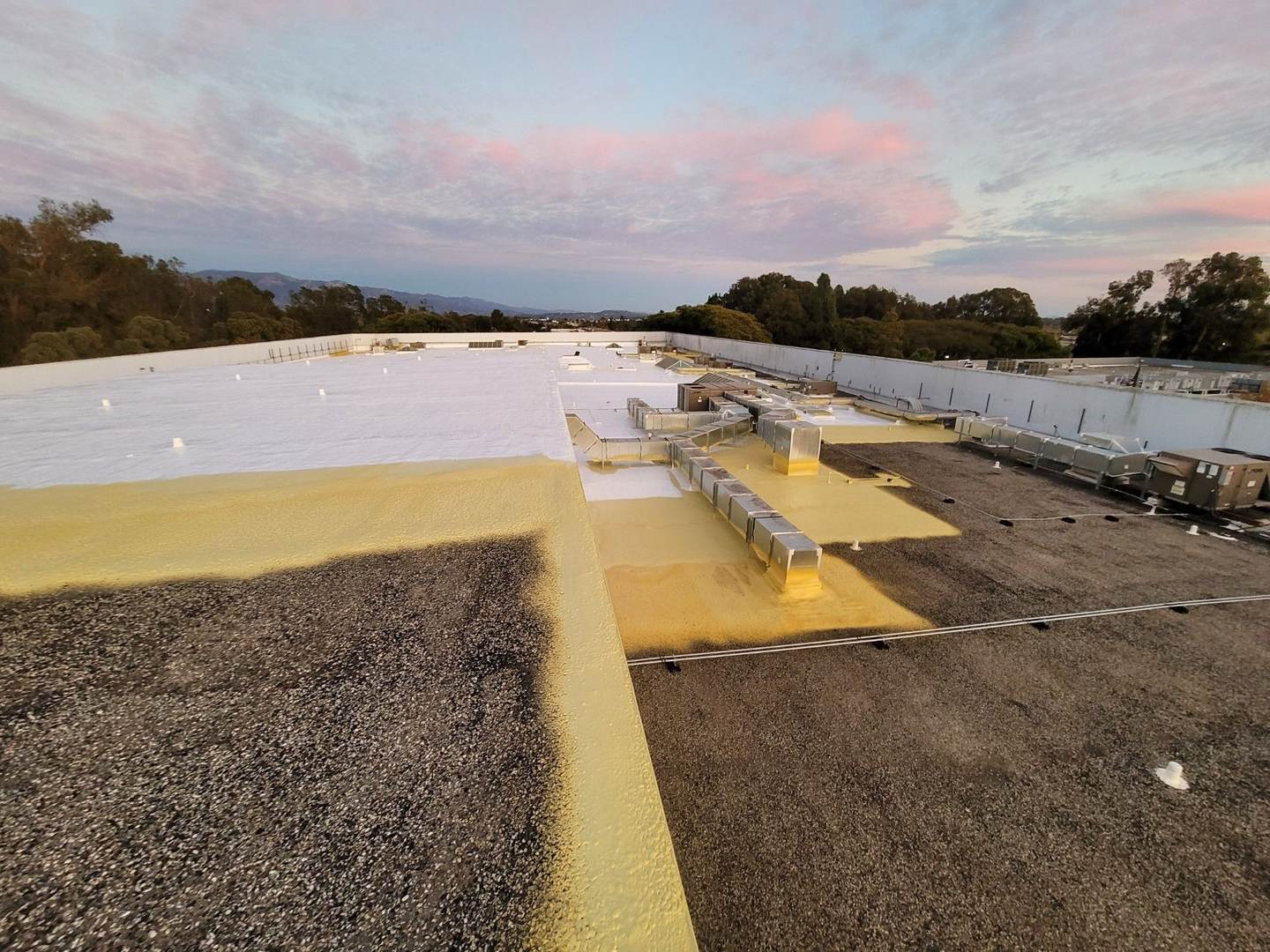
Spray foam is sprayed on as one seamless layer, with no seams to open up, and it adds insulation on top of the building. When the existing roof is sound, foam can often go right over it, including old metal roofs and old gravel roofs. On a gravel roof, the loose gravel comes off, wet or damaged areas are cut out and repaired, and the foam goes over the top. The foam is then protected with a coating.
Roof coatings over foam and existing roofs
A roof coating protects spray foam from the sun, and on a sound existing roof, a coating can restore the surface without a replacement at all. We use Mule-Hide silicone and acrylic coatings. Depending on the system, a coating can last up to 20 years in some cases, and when it wears, it can be cleaned and recoated instead of replaced.
We lay the options out side by side in your estimate, so you can compare them line by line. Warranty length depends on the roof system, typically 20 years.
Fix the drainage while the roof is open
Ponding water and clogged drains cause many of the flat-roof leaks we see. Flat roofs aren't truly flat: they need enough slope to move water to the drains, scuppers and gutters. When a roof is being replaced, it's the best time to fix the spots where water sits for days after a storm. We look at how water moves across the roof, check the drains and scuppers, and include any drainage fixes in your estimate. Read signs your commercial roof drainage is failing to learn what to look for.
Keeping your business open during the job
A new roof doesn't have to shut you down. We work on occupied buildings, from stores and offices to warehouses running shifts, and we plan the job with you before we start:
- The schedule. Which parts of the roof we'll work over and when, and whether any work should happen outside your business hours.
- Access and staging. Where materials and equipment will sit, and how to keep entrances, parking and delivery areas open for your customers and staff.
- Rooftop equipment. If HVAC units or other equipment need attention during the job, we'll tell you ahead of time so you can plan with your service contractors.
- Day-to-day updates. You'll know what to expect each day and who to call with questions.
All of this is spelled out in your written estimate, so there are no surprises for your crew or your customers.
Leaking now? Emergency tarping
If the roof is leaking while you decide what to do, call (661) 213-2203. Office hours are 8 a.m. to 5 p.m., seven days a week, and someone is on call after hours. We tarp roofs in emergencies to help limit damage until the repair or replacement can be made.
Help with insurance claims
If a storm or wind damaged your roof, we can help with your insurance claim. We inspect the roof, document the damage and give you a written, itemized estimate for the work. Your insurance company decides what is covered, and we work from there with you.
After the new roof: maintenance plans
A new roof lasts longest when someone keeps an eye on it. We offer maintenance plans for commercial roofs, so inspections, drain cleaning and small repairs happen on a schedule, and problems get caught before they turn into leaks. Ask about a plan when we look at your roof.
How a commercial roof replacement works
- Call or send a request. Call (661) 213-2203 or send us the details. Tell us about the building and what the roof is doing.
- We inspect the roof. Layers, wet areas, the deck, drainage, flashing and rooftop equipment.
- Written, itemized estimate. Recover or tear-off, the roof systems that fit, and the price, line by line.
- A plan around your business. Schedule, access and staging, agreed on before we start.
- The new roof. Installed in the order we planned, with the work area cleaned up as we go.
Commercial roof replacement across Kern County
From our office at 6321 Almond Dr in Bakersfield, we replace commercial roofs across Kern County, including Oildale, Shafter, Wasco, Delano, Taft and Tehachapi, and just outside the county in Visalia and Porterville. See all of our service areas, or read more about our commercial roofing services. Our crew includes Spanish speakers. Hablamos español.
Commercial roof replacement FAQ
Can a new roof go over my existing commercial roof?
Sometimes. It depends on how many layers the roof already has and what shape they're in. The existing roof has to be dry and solid, and any wet or damaged material has to come out. We inspect the roof first and tell you whether a recover or a tear-off is the right call.
Can you replace our roof while the business stays open?
Yes. We work on occupied buildings and plan the schedule, access and staging with you before we start, so your customers and staff can keep working.
What's the best replacement roof for a flat commercial building?
It depends on the building and the roof on it now. TPO is a white single-ply roof that suits large flat roofs, spray foam adds insulation and can often go over a sound existing roof, and coatings protect foam and restore sound roofs. We compare the options in a written estimate.
How much does a commercial roof replacement cost?
It depends on the size of the roof, its condition, the number of layers, the system you choose and how much prep the roof needs. We give free, written, itemized estimates. Call (661) 213-2203.
How long does a roof coating last?
We use Mule-Hide silicone and acrylic coatings. Depending on the system, the roof underneath and how it is maintained, a coating can last up to 20 years in some cases, and it can be cleaned and recoated instead of replaced.
Can you help with an insurance claim?
Yes. If a storm or wind damaged your roof, we inspect it, document the damage and give you a written, itemized estimate. Your insurance company decides what is covered.
Do you offer maintenance plans after a new roof?
Yes. A maintenance plan puts inspections, drain cleaning and small repairs on a schedule, so problems get caught before they turn into leaks.
Get a free commercial roof replacement estimate
Helpful reading: Roof replacement vs overlay · TPO roofing guide · Commercial roof maintenance plans
Tell us about the building, the roof and your schedule, and we'll set up a time to look at the roof.
Pioneer Roofing · 6321 Almond Dr, Bakersfield, CA 93308 · (661) 213-2203 · 8 a.m.–5 p.m. daily (Mon–Sun), on call after hours · Pioneer Roofing · Licensed & Insured · CA License #976470
Serving all of Kern County and nearby areas, plus larger projects elsewhere in California.
Related: Commercial roofing · Commercial roof repair · TPO roofing · Spray foam roofing · Roof coatings · Roof inspection