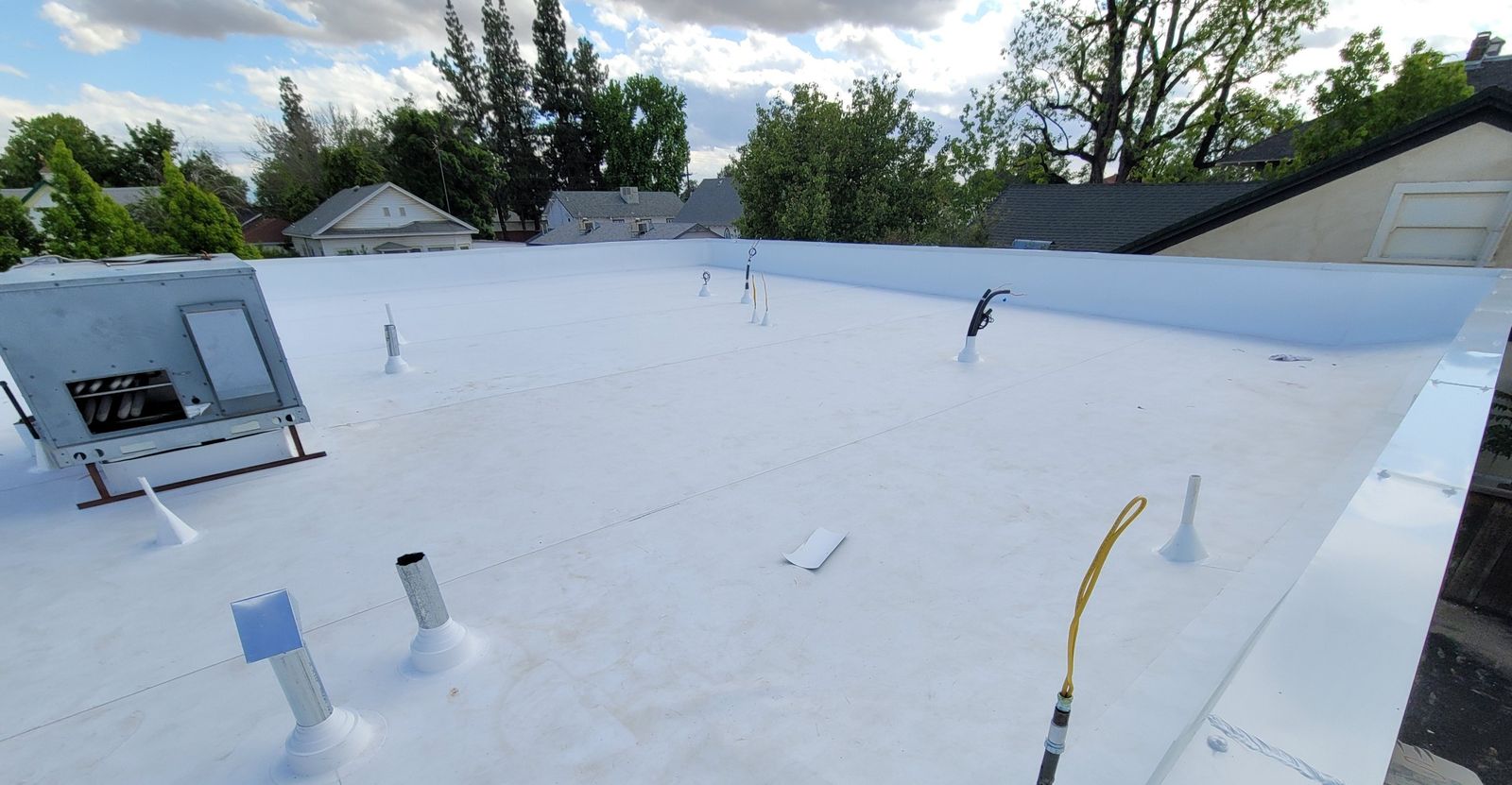
TPO Roofing Guide: Lifespan, Heat and Cost in Bakersfield
TPO is one of the most popular roofs for flat and low-slope buildings, and it's a great match for a place as hot and sunny as Bakersfield. This guide covers what a TPO roof is, why it handles Valley heat so well, how long it lasts, what installation looks like and how repairs work. If you're ready to talk about a project, see our page on TPO roofing in Bakersfield.
What is a TPO roof?
TPO stands for thermoplastic polyolefin. It's a single-ply roofing membrane, which means one tough, flexible sheet does the waterproofing instead of several layers built up on the roof. The sheets come in wide rolls, so the finished roof has fewer seams than many other flat roofs.
The "thermoplastic" part is what makes it special. Heat softens the membrane, so where two sheets overlap, the edges are welded together with hot air. The seam becomes one continuous piece of roofing. The membrane usually goes over rigid insulation board, and matching membrane is welded around walls, curbs, pipes, drains and edges. TPO products we install include Mule-Hide TPO.
Why TPO works so well in Bakersfield heat
A bright white surface. White TPO reflects much of the sunlight that would otherwise bake into the roof, so the roof surface stays cooler through our long, triple-digit summers.
Welded seams. The seams are fused, not glued, so they don't depend on adhesives holding up in the heat.
Easy to keep an eye on. The smooth, light surface is easy to check and easy to keep clean.
A fit for California's cool roof rules. White TPO is one of the roof options used where California's Title 24 energy code calls for a reflective "cool roof." Whether those rules apply depends on your building and the scope of work, and that's confirmed during permitting.
How long does a TPO roof last?
A TPO roof is a long-term roof. How long yours lasts comes down to the membrane itself, the quality of the installation (especially the welds and flashing details), how well the roof drains and how it's cared for over the years. Warranty length depends on the product, typically 20 years, and we spell out the warranty for your roof in your estimate.
A few simple habits help a TPO roof go the distance:
Keep drains and scuppers clear so water moves off the roof.
Rinse off the dust that settles on roofs around Kern County, so the white surface keeps reflecting the sun.
Have the roof looked at from time to time and after big storms. A roof inspection catches small things while they're still small.
Reflectivity and energy: keeping the building cooler
On a dark roof, the summer sun turns the roof into a heater sitting on top of your building. A white TPO roof reflects much of that sunlight instead, which can help keep the space below cooler and take some of the load off your air conditioning during a Bakersfield summer.
That reflectivity is also why white TPO comes up so often with Title 24 cool roof requirements. For more on how reflective roofs and California's energy code fit together, read reflective roof coatings and Title 24.
What a TPO installation looks like
Roof evaluation. We get on the roof and check the existing roofing, the deck, how water drains and everything that sits up there: units, vents, skylights and drains.
Written, itemized estimate. Tear-off or recover, insulation, membrane, flashing details and the price, line by line. We pull the permits for the job.
Prep. Old roofing comes off where needed, and any wet or damaged material is replaced so the new roof starts on a solid, dry base.
Insulation and membrane. Insulation board goes down, then the membrane is rolled out and secured.
Welding and details. Every seam is heat-welded, and walls, curbs, pipes, drains and edges are flashed with matching membrane.
Final check. We walk the finished roof, check the welds and details, and clean up.
On commercial buildings, we can schedule the work around your business hours and on occupied buildings, and we plan the job with you ahead of time.
Can TPO go over an existing roof?
Sometimes, yes. Whether TPO can go over your current roof depends on how many layers the roof already has and what shape they're in. We inspect the roof first to see what's going on before we recommend it, and any wet or damaged material has to come out either way. When a recover is possible, it can save the time and cost of a full tear-off. When it isn't, we'll price a new roof on a clean deck. For more on that choice, read roof replacement vs overlay.
TPO roof repair
One of the best things about TPO is how repairable it is. Because the membrane is heat-weldable, a damaged spot can often be fixed by welding a patch of new membrane right over it, as long as the sheet around it is in good shape. The patch fuses to the roof and becomes part of it.
Typical repairs include re-welding a seam, patching a spot where a dropped tool or storm debris hit the roof, and re-flashing around a wall, curb or rooftop unit. If your roof is leaking, see commercial roof repair. Someone is on call after hours, and we tarp roofs in emergencies.
What goes into the cost of a TPO roof
Every roof is different, so the honest answer is a price for your roof. The main things that shape it:
The size of the roof and how easy it is to reach.
Whether the old roof comes off or the new membrane can go over it.
How much insulation the building needs.
How many units, vents, skylights, drains and edges need detail work.
Any deck repairs found once the old roof is opened up.
We give free, written, itemized estimates, so you can see exactly what's included.
TPO on homes, too
Many Bakersfield homes have a flat or low-slope section over an addition or patio where shingles and tile don't belong. We put TPO on flat sections of houses too. See residential roofing.
TPO roofing FAQ
Is TPO a good roof for Bakersfield heat?
Yes. It's a popular choice for hot, sunny climates. The white membrane reflects much of the sun's heat, and the welded seams don't rely on adhesives.
How long does a TPO roof last?
It depends on the membrane, the installation, how the roof drains and how it's cared for. Warranty length depends on the product, typically 20 years.
Can a TPO roof be repaired?
Yes. Seams can be re-welded, and damaged spots can be patched by welding new membrane over them.
Can TPO go over my existing roof?
Sometimes. It depends on how many layers are already on the roof. We inspect first, and any wet or damaged material comes out either way.
What brand of TPO do you install?
TPO products we install include Mule-Hide TPO.
Planning a TPO roof?
Pioneer Roofing installs and repairs TPO roofs on warehouses, stores, offices, shops and homes across Kern County and surrounding areas. Call (661) 213-2203 or request a free estimate, and see our commercial roofing services.
