Signs of Heat Damage to Roofs in Kern County
Kern County summers are hard on roofs. Week after week of triple-digit afternoons, strong sun and very little cloud cover add up, and a roof takes most of that heat before it ever reaches your attic. Heat damage rarely shows up as one dramatic failure. It builds slowly, and then one fall storm finds every weak spot at once. Here are the signs to watch for on homes and commercial buildings in Bakersfield and around the county, and what to do about them.
Why heat is so hard on a roof
A roof surface in full summer sun gets far hotter than the air around it. Then the sun goes down and it cools off again. That daily swing makes roofing materials expand and contract, over and over, all summer long. Over the years it dries out the oils in asphalt shingles, works fasteners loose on metal roofs, stresses seams and flashing, and breaks down the underlayment under tile. Sunlight also wears on any roof surface that isn't protected. None of this means your roof is failing, but it does mean a roof in the Valley ages differently than the same roof somewhere cooler.
Signs of heat damage on shingle roofs
Curling or cupping shingles. Edges that lift up or the middle of the shingle sinking are classic signs of a shingle drying out.
Granules in the gutters or at the downspouts. Those little colored granules protect the asphalt from the sun. When a lot of them wash off, the shingle underneath wears faster.
Cracked or brittle shingles. Shingles that crack when they flex, or tabs that have broken off after a windy day.
Blistering. Small raised bubbles on the surface of the shingle.
Faded, patchy color across the sunniest slopes, usually the south and west sides.
One or two of these in a small area can often be handled with a roof repair. When they show up across the whole roof, it's usually time to talk about roof replacement.
Signs of heat damage on tile roofs
Tile itself handles heat well, which is why it's so common in Bakersfield. The weak point is the underlayment under the tile. Heat slowly dries it out until it cracks or crumbles, and then the water that always gets past the tile has nowhere to go but into the house. Signs to look for:
Ceiling stains or leaks during the first real rain, even though the tile looks fine from the ground.
Cracked or slipped tiles, especially where people have walked on the roof.
Bits of dark, brittle underlayment visible at the edges or under a broken tile.
When the tile is in good shape, a tile lift-and-relay is often the fix: the tile is lifted, new underlayment goes down and the tile is relaid.
Signs of heat damage on flat and commercial roofs
Flat and low-slope roofs face the sun all day with no slope to shade any part of them. On commercial buildings, watch for:
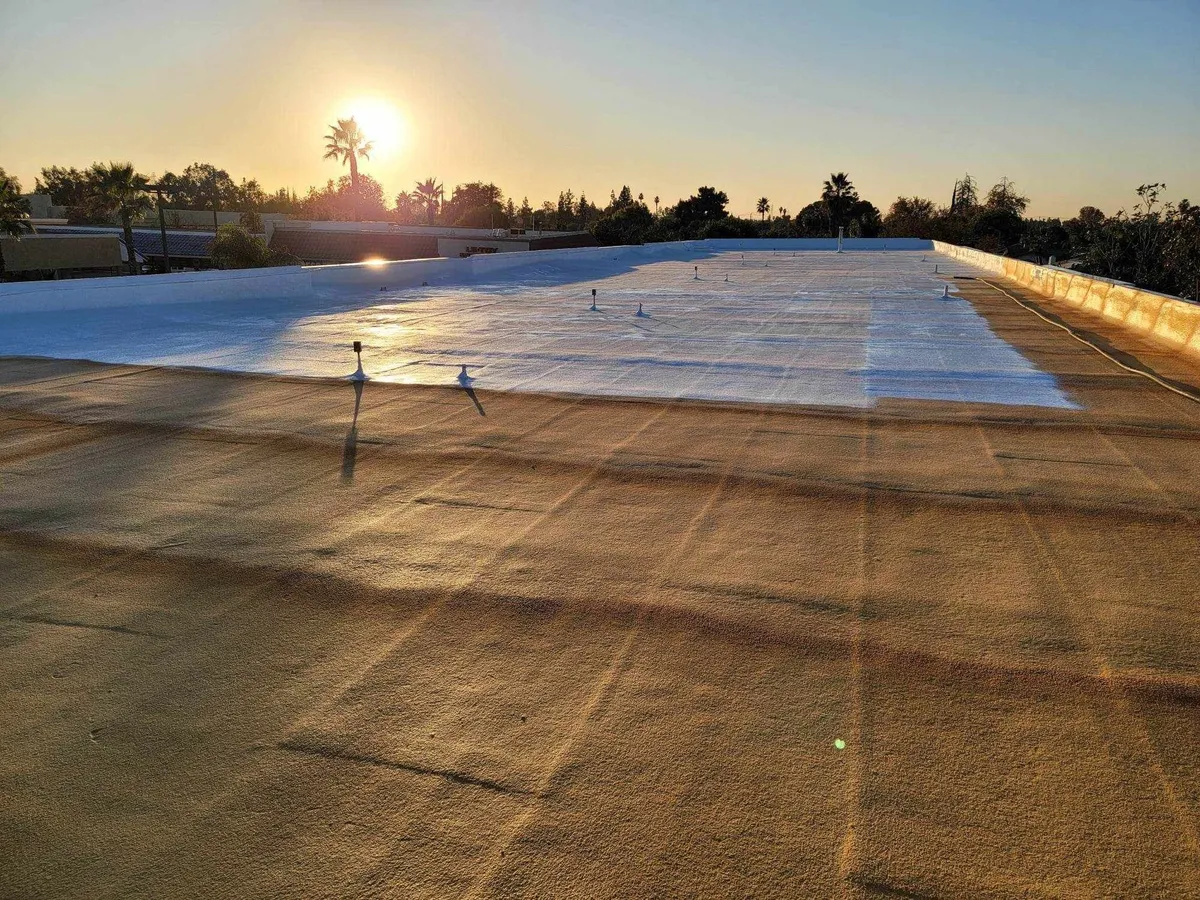
A worn or chalky coating. On coated and spray foam roofs, the coating is what protects the foam from the sun. When it's thin, chalky or has spots worn through, the foam underneath is exposed.
Cracking or "alligatoring" on older built-up and asphalt roofs, where the surface breaks into a pattern of small cracks.
Seams and flashing pulling loose at walls, curbs and rooftop units.
Loose fasteners and open laps on metal roofs, where panels have expanded and contracted for years.
Dirt and dust buildup on a white roof. It doesn't damage the roof by itself, but it cuts down how much sun the roof reflects.
Many of these roofs can be cleaned, repaired and recoated instead of replaced, if the roof underneath is dry. Depending on the system, a roof coating can last up to 20 years in some cases. Our commercial roof repair page covers the repair side.
Signs inside the building
Some of the first clues aren't on the roof at all:
Water stains on ceilings or around light fixtures after the first rain of the season.
A musty smell or damp insulation in the attic.
Daylight showing through the roof deck in the attic.
Rooms right under the roof that feel much hotter than they used to.
Don't forget swamp coolers and rooftop equipment
Swamp coolers, AC units, vents and solar mounts all have flashing around them, and that flashing takes the same heat as the rest of the roof. Cooler stands in particular are a common leak point on older homes. If you're taking a cooler out, the opening in the roof has to be closed up properly. See our guide to removing a swamp cooler and closing the roof opening.
When to have your roof checked
The best time is early fall, after the worst of the summer heat and before the rainy season. That gives you time to fix small problems before the first storm turns them into leaks. It's also worth a look after a big windstorm or if you notice any of the signs above. A roof inspection covers the whole roof, and you get a written estimate that lays out your options.
Things you can do yourself, safely from the ground: look at the roof with binoculars, check the gutters and downspouts for granules, and peek in the attic with a flashlight after a rain. Please leave walking on the roof to a roofer, especially on tile and in the heat.
Repair, recoat or replace?
Heat damage doesn't automatically mean a new roof. A few curled shingles, a cracked tile or a loose piece of flashing can usually be repaired. A worn coating on a sound flat roof can often be recoated. When the damage is spread across the whole roof, or the underlayment is gone, replacement or a tile lift-and-relay is usually the better value. Most home re-roofs take about 3 days. If your roof was damaged in a storm, we can also help with your insurance claim.
Roof heat damage help in Bakersfield and Kern County
Pioneer Roofing works on homes and commercial buildings across Bakersfield and Kern County, from shingle and tile homes to spray foam, coated and TPO commercial roofs. Office hours are 8 a.m. to 5 p.m., seven days a week, and someone is on call after hours for leaks that can't wait. Our crew includes Spanish speakers. Hablamos español. Call (661) 213-2203 or request a free estimate. More on our residential roofing and commercial roofing work.
